info@ebookwriters.co.uk
 +44 7460 751919


Art is a constantly evolving thing. New generation, new ideas, new technology, and new cultural expressions. Contemporary vs modern style is still a subject of discussion among artists, students, designers, collectors, and homeowners,
Both are the same term, but represent two different periods in art history. These differences are important to be aware of when looking at paintings, architecture, interiors, sculpture, photography, or digital art, and they help make them look better.
Furthermore, modern and contemporary collections are accessible in the UK through digital exhibitions and online galleries, and the world of art is even more accessible than ever.
What are Contemporary Arts?
There is no single style that can be applied to contemporary art. Rather, it's a piece of art created in the present time and period in just about any medium, such as:
- Painting
- Digital illustration
- Installation art
- Performance art
- Photography
- Video art
- Street art
- Mixed media
- Virtual reality experiences
The contemporary artist is free from the conventions and historical movements that shared common principles.
Characteristics of Contemporary Vs Modern Style!
Here are the characteristics of contemporary style:
- Material: There is more than one material that is available for use, other than Canvas. In today's artwork, re-purposed items, fabric and electronic screens are used, along with programming, augmented reality, and sound art.
- Audience interaction: Many exhibits invite visitors to not only look at the art but also to be part of the art-making process.
- Global views: Today's artists seek to draw from a range of cultures instead of from a single nation's culture.
These books can help you understand contemporary vs modern style better:
- The Story of Contemporary Art by Tony Godfrey
- Making Contemporary Art: How Today's Artists Think and Work by Linda Weintraub
- The Short Story of Contemporary Art by Susie Hodge
Contemporary Art UK - Thriving Landscape
The UK has one of Europe's biggest hubs for contemporary creativity, with its cultural heritage.
There are internationally renowned galleries of emerging and established artists in cities such as London, Manchester, Glasgow, Bristol, Liverpool, and Edinburgh.
In addition, Tate Modern has been a leader in engaging the public with contemporary art with its immersive exhibitions and learning programmes.
The Creative Industries in the United Kingdom contribute more than £120 billion to the UK economy each year (UK Government's Creative Industries statistics).The visual arts continue to play an important role in galleries, museums, design agencies, publications, and the digital realm.
Online marketplaces are also a great option for many independent artists, enabling them to sell their paintings to collectors around the globe without having to travel to physical galleries.
Indeed, there are many books and ebooks that provide information on the current arts culture in the UK and discuss the unique themes, painters, and sculptors the country is home to.
Contemporary Vs Modern Style
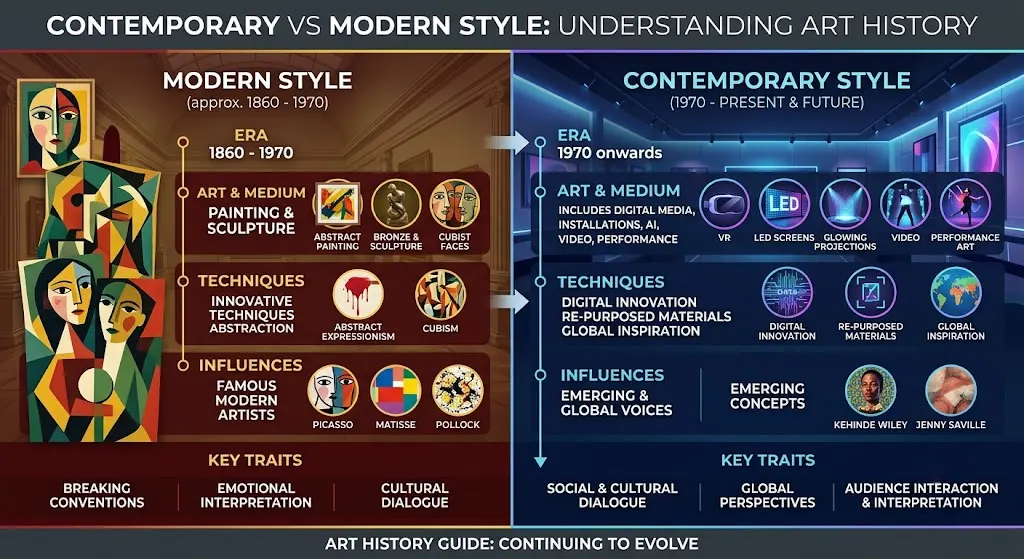
While often used interchangeably, both contemporary and modern styles are different. While modern art is anchored in the early to mid-20th century, contemporary art does not have a fixed anchor and changes with time.
Difference Between Modern vs. Contemporary Art
| Modern Art | Contemporary Art |
|---|---|
| Created between 1860 and 1970 | Created from 1970 onwards |
| Innovative art techniques | Has social, political, and cultural dialogue. |
| Mainly a painter and sculptor | Includes digital media, installations, portraits, AI, video and performance. |
| Influenced by artists | Individual concepts as drivers of artistry |
| Experiments with abstraction | Invites the audience to participate and interpret their creative thinking. |
| For example, Marvel and DC comics are the prime examples of American modern art. | For example, Japanese comics like Manga and Manhwa are the perfect examples of contemporary art. |
This separation is what makes the contemporary exhibiting so interactive, conceptual, and open to several readings.
Contemporary Vs Modern Style: Why the Confusion Exists?
There are some movements that make it hard to distinguish between those two, like:
- Many museums house collections of modern and contemporary works in a single location.
- Modern furniture and contemporary decorative elements are often paired together by interior designers.
Sometimes “modern” is merely a way for art dealers to refer to works that look clean and minimalist, even if they are from the contemporary period.
Knowing their history helps bring a lot of clarity.
Famous Modern Artists Who Changed the History of Art.
The twentieth century brought some famous modern artists whose signature can be seen in design, advertising, fashion, architecture, and digital illustrations.
The most influential famous modern artists are:
- Pablo Picasso
- Henri Matisse
- Wassily Kandinsky
- Salvador Dalí
- Jackson Pollock
- Frida Kahlo
- Georgia O’Keeffe
- Piet Mondrian
They invented works that changed the ways of artistic expression, as they were not realistic but open to emotional interpretation. For example:
- Picasso’s Cubism transformed the perspective
- On the other hand, Kandinsky showed that it was possible to evoke human emotion through color psychology.
- Pollock revolutionized painting with his drip approach and inspired many abstract artists.
These artists continue to inspire today’s art across both print and digital media, including book covers, canvases, etc.
Looking to create stunning abstract book covers inspired by Contemporary or Modern Art? Professionals have you covered.
Whether you need help in designing your contemporary style Manhwa novel cover or want abstract help, you can get your book covers done by professional artists and designers at eBook Writers UK.
Hire Professionals Now!
Modern Artists UK - Britain's Great Contribution to Art!
The UK has given birth to many internationally known modern artists who remain popular for their art.
Notable names include:
- Henry Moore
- Barbara Hepworth
- Francis Bacon
- David Hockney
- Bridget Riley
They each brought unique artistic styles that influenced generations of painters, sculptors, and designers.
For example, David Hockney remains important for his work that combines modern art forms with digital artistry. His iPad sketches illustrate how technology can broaden the scope of artistic practice while still retaining robust traditional compositional skills.
What is Contemporary Design?
To easily understand the meaning of contemporary design, it is essential to differentiate between contemporary and modern styles.
Contemporary design is the product of the current times, style, materials, and lifestyle. Unlike modern design that is defined by a movement of the early and mid-20th century, contemporary design is constantly evolving as it is shaped by the times, technology and social values.
Designers don't follow a set of rules. The interior of a contemporary living space may incorporate natural wood, polished concrete, curved furniture, sustainable textiles, and smart home gadgets. The focus is on functionality, not on sacrificing visual appeal.
This trend has gained momentum since the advent of sustainable design. The study by World Green Building Council reveals that buildings are responsible for around 39% of carbon emissions globally due to their energy use and materials,
This is a reason for architects and designers to use environmentally friendly materials and provide energy-efficient interiors.
What is Contemporary Interior Design?
The contemporary house interior is designed with comfort, simplicity, style and adaptability in mind. All elements have a purpose and add a visual balance.
Today's interior spaces are designed to be more functional and practical, with a focus on simplicity and minimalism.
Instead of filling rooms with decorative elements, contemporary interior design emphasizes simplicity and minimalism, with a focus on clean, modern lines and space-saving solutions.
There are a number of characteristics that characterize modern houses throughout the UK, such as:
- Open Living Spaces: The division of kitchens, dining rooms, and lounges by walls is now less prevalent. Open layouts allow for abundant natural light and flexibility for families living in the modern day.
- Natural Materials: Wood, stone, linen, marble, and recycled materials are used to provide warmth without cloying the room. The use of finishes and furniture has increasingly come into focus in sustainability.
- Statement Artwork: Art can be the focal point of any room. Large-scale abstract paintings, mixed-media installations, and contemporary art painting collections add character without overdecorating.
- Smart Home Technology: Contemporary interiors, with their seamless integration of lighting systems, heating controls, security devices and entertainment systems, are convenient and maintain a minimalist design aesthetic.
According to Houzz UK Renovation Trends, homeowners are increasingly putting money into kitchen improvements, energy efficiency, and flexible living areas, as their work and lifestyle habits evolve.
Contemporary Art Painting: What You Should Know!
A contemporary art painting is not likely to be a standard painting. Artists use traditional and experimental techniques to express themselves and address issues in the world.
Popular themes include:
- Climate change
- Mental health
- Cultural identity
- Urbanisation
- Artificial intelligence
- Migration
- Gender equality
- Consumer culture
Materials have grown way beyond oil and acrylic paint. Modern painters use textiles, photography, digital printing, metal leaf, recycled plastic, and mixed media collage in their paintings.
Additionally, contemporary painting is less structured than other historical art movements, and it's all about expression. No artist falls into a collective movement; no artist's language is shared, but rather each artist creates their own.
Online galleries have also changed how art is accessed, making it accessible to a wider audience. The new digital exhibitions give collectors the opportunity to discover emerging artists and provide opportunities for creatives across the UK and beyond.
Top Contemporary Portraiture Artists
Portraiture has undergone extraordinary changes in the modern period. Commissioned portraiture remains in fashion, but today's artists continue to refine the genre through photography, digital illustration, collage, sculpture, augmented reality, and conceptual installation.
Some prominent Contemporary portraiture artists are:
- Jenny Saville: Associated with monumental figurative paintings, Saville subverts the standard of beauty, expressing himself through the brush and the realism of anatomical forms.
- Kehinde Wiley: Wiley's classical portraiture is a reinvention of the traditional genre by situating modern faces in compositions based upon historic European paintings.
- Amy Sherald: Sherald's portrait of Michelle Obama is a worldwide sensation. Her distinctive use of grayscale skin tones draws readers' attention to identity, emotion, and individuality.
- Lynette Yiadom-Boakye: Yiadom-Boakye creates fictional portraits that prompt viewers to imagine stories outside of the historical record while working in the UK.
These artists prove that portraiture is still one of the most fluid forms of contemporary visual culture.
Impact of Contemporary Vs Modern Style in Everyday Life
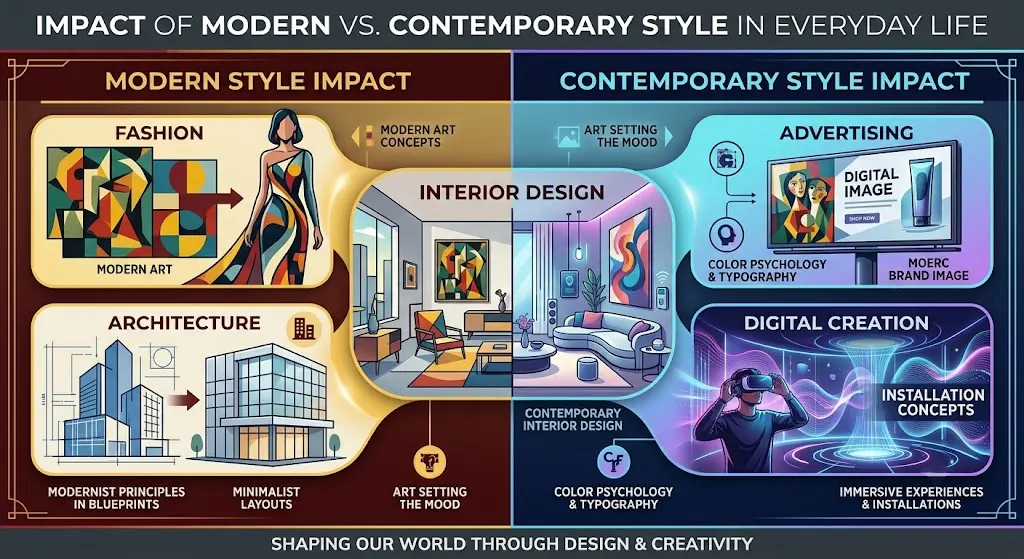
The impact of contemporary vs modern style is not limited to galleries and museums. Instead, the ideas are used in various fields and industries daily, such as:
- Colour schemes and abstract design elements are taken from famous paintings and used in fashion.
- Minimalist principles are brought to the architects' desk through modernist movements.
- Interior designers arrange interior rooms with modern art to set a mood and character.
- The advertising agencies use artistic composition, typography, and colour psychology to reinforce brand image.
- Digital creators create immersive experiences using concepts pioneered by contemporary installation artists.
Wrap Up!
Understanding contemporary vs modern style provides a clearer sense of the evolution of art over time.
Both movements developed within history and culture and have influenced how creativity is perceived and experienced across generations. They also influence the fields of architecture, design, fashion, and everyday life.
Knowing the difference between them allows students, artists, collectors and art enthusiasts to understand the interpretation of art.
FAQ’s
1. What is Contemporary Vs Modern Style?
Modern art is broadly defined as works produced from the 1860s through the 1970s, whereas contemporary art is defined as works produced since the 1970s and is currently in trend.
2. What are contemporary arts?
Contemporary art is painting, sculpture, photography, installation art, digital media, performance art, video art, or mixed media works created in the present day.
3. Does today’s art have greater value than modern art?
Value is based on the artist, rarity, historical value, condition, and collector demand, and not necessarily on the art period.
4. Who are the influential modern artists?
Pablo Picasso, Henri Matisse, Wassily Kandinsky, Salvador Dalí, Frida Kahlo, Jackson Pollock, and Piet Mondrian are still among the most influential modern artists.
5. What does the term “contemporary interior design” mean?
Today's interior design emphasizes simplicity, utility, eco-friendly elements, daylighting, and flexibility to accommodate modern lifestyles.
6. Why is modern art often hard to comprehend?
Many contemporary artists emphasize ideas and concepts rather than realistic representation, inviting viewers to consider meaning in several ways.
7. Why is learning art history important?
Art history boosts cultural understanding, visual literacy, creative thinking, and appreciation for historical events.
8. Contemporary Vs Modern Style: Can they be combined?
Yes! Many designers successfully combine modern and contemporary styles to create balanced and timeless artwork.
9. Which modern artists are from the UK?
Notable modern British artists include David Hockney, Henry Moore, Barbara Hepworth, Francis Bacon, and Bridget Riley.