info@ebookwriters.co.uk
 +44 7460 751919


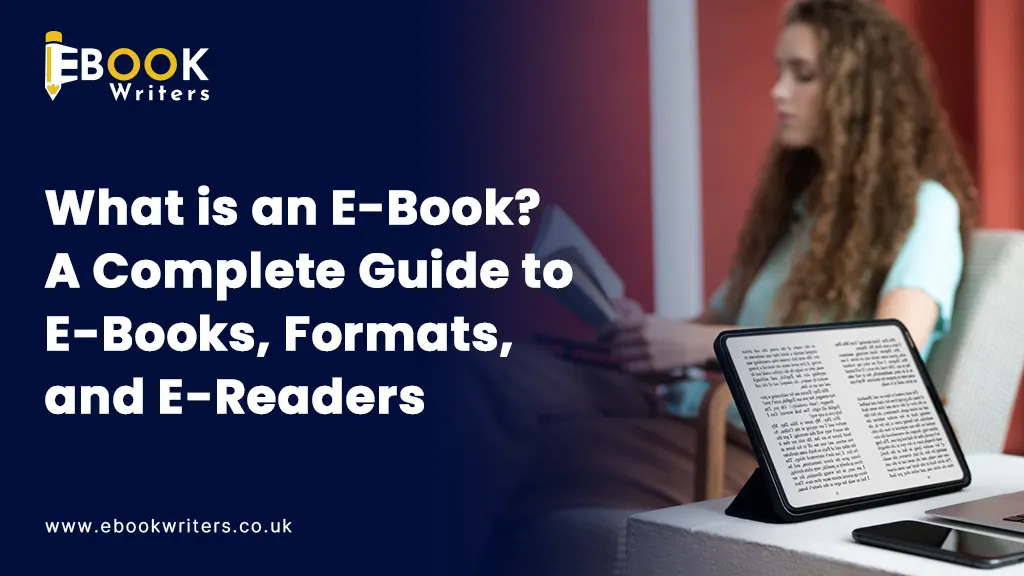
People who read books know how the publishing world has changed. From searching for paperbacks on library shelves to having an entire library on your smartphone, tablet, or dedicated reading device, it is all possible because of e-books.
However, digital publishing has its own terminology, such as e-book, ebooklet, e-textbook, e-reader, EPUB, MOBI, AZW3, PDF, fixed layout, reflowable text, and DRM. If you are new to the world of ebooks, then you are in the right place.
Whether you are an aspiring author, a publisher, a student, or just a regular reader, these terms are crucial to know so you can easily navigate the digital publishing landscape.
Understanding E-books and Digital Publications
What is an e-book?
E-book stands for electronic book a digital version of a book that can be read using an electronic device. These are very different from traditional books because they do not require printed pages, binding, or physical storage.
An e-book can contain text, images, illustrations, hyperlinks, tables, and other digital elements. Moreover, e-books are designed to adapt to different screen sizes and reading preferences. Readers appreciate being able to adjust text size, font, spacing, and brightness to suit their needs, which is a key reason for their popularity.
Furthermore, e-books cover a wide range of genres, from novels and biographies to business guides, self-help books, academic resources, and technical manuals. The best part is how easy they are to distribute, purchase, and access instantly without waiting for printing. They also require no physical space, allowing readers to carry hundreds or even thousands of e-books on a single device.
What is an ebooklet?
An ebooklet is a concise, booklet-style digital publication. Unlike a full-length book that comprises multiple chapters and extensive content, a booklet is only a few pages long and focuses on a single, narrow topic.
For example, an ebook writer might craft an ebooklet offering writing tips, while a business might create a short guide for its products and services.
Due to their compact nature, ebooklets are particularly useful for guides, tutorials, checklists, informational resources, and introductory materials.
What is an e-textbook?
An e-textbook is a digital version of a printed academic textbook intended for school, college, or university-level students. It delivers core learning material in electronic form and often includes chapters, diagrams, references, exercises, quizzes, links, and other interactive features.
Key features of e-textbooks include interactive tools that allow readers to highlight text, make notes, listen to audio, watch video clips, or take practice quizzes. These are convenient to access and can be synced across compatible devices.
While "e-book" is a broad term for any digital book, an e-textbook is a specific category tailored for education.
Understanding E-book Devices and Formats
What is an e-reader?
An e-reader is an electronic device designed specifically for reading digital books, magazines, and other publications. Dedicated e-readers are lightweight and portable.
If you want your smartphone, laptop, or tablet to function as an e-reader, you can simply download apps like Kindle or Google Play Books. Dedicated e-readers typically use e-ink screens, offer massive storage, and feature remarkably long battery life.
Moreover, readers can change font sizes, search for words, highlight passages, and add bookmarks or notes, depending on the device and software.
Keep in mind the key distinction: an e-book is the digital file itself, whereas an e-reader is the physical device or application used to read it.
What is the EPUB format?
The EPUB format is the most widely used e-book format in the industry. Its primary advantage is support for reflowable text. Reflowable text automatically adjusts its layout, line breaks, and page structure to fit different screen sizes, device shapes, and user font choices. This format is supported by most reading apps and devices (with Kindle now supporting EPUB delivery as well).
EPUB is ideal for novels, guides, and other text-heavy publications.
Are you overwhelmed by the complications in the book-writing process?
Don't worry, and let our professional ebook writing service handle everything from scratch.
Connect with us now!
What is the MOBI format?
MOBI is an older e-book format that also features reflowable text, lightweight file size, and basic formatting. It was historically associated with Amazon Kindle. However, new formats such as AZW3 and KFX have largely replaced MOBI.
Therefore, authors must check the current requirements of their chosen publishing platform before selecting an e-book format.
What is the AZW3 format?
AZW3, also known as Kindle Format 8 (KF8), was created by Amazon for its Kindle devices and apps. It was introduced as an improvement over older Kindle formats to provide better support for advanced formatting, typography, and styling.
Key features include enhanced design capabilities, DRM protection, and interactive elements.
DRM (Digital Rights Management) is a security technology used by publishers to prevent unauthorized copying, sharing, and piracy. It limits e-books to specific devices, apps, and user accounts through encryption, device limits, functional restrictions, or expiration controls.
What is the PDF format?
The PDF format is a popular file type used for e-books, reports, manuals, brochures, and other digital documents.
It features a fixed layout, meaning it maintains a predetermined arrangement of text, images, and illustrations. Unlike reflowable e-books, the content does not adjust to fit the reader’s screen; everything remains fixed regardless of the device used.
Therefore, PDF formats are best suited for books with heavy graphics, complex tables, charts, or precise visual designs. However, they can be less comfortable to read on smaller screens like smartphones.
Summary
An e-book comes in different formats and forms to meet various reading and publishing needs. Whether you are choosing between an e-reader, e-textbook, or ebooklet, understanding these distinct formats is essential. Choosing the right e-book format is crucial, as it directly influences the overall reader experience.