info@ebookwriters.co.uk
 +44 7460 751919


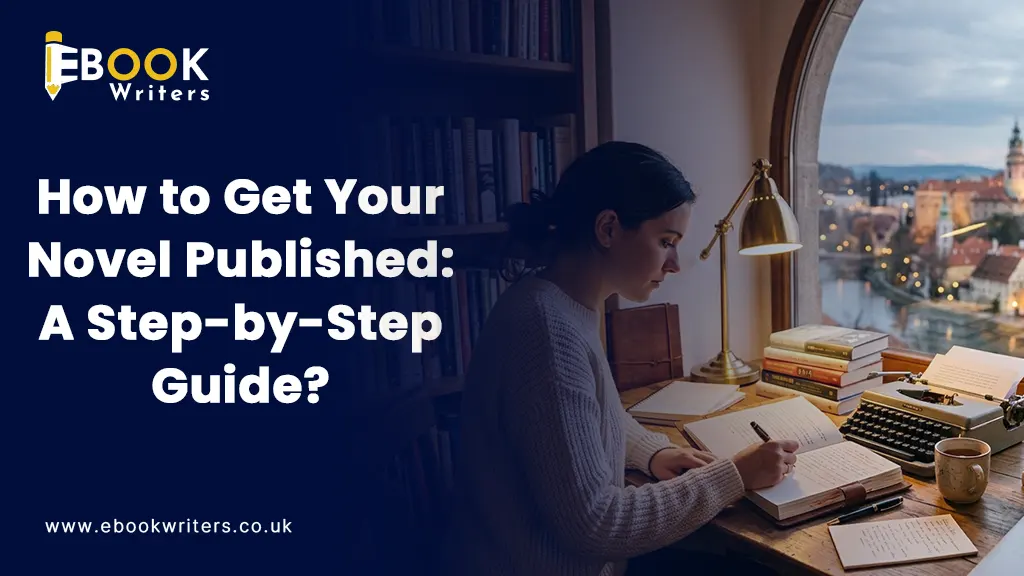
I am guessing that your manuscript is finally complete, and now you are wondering how to get your novel published, and that's why you are here.
First of all, congratulations on completing a novel. It is an incredible achievement, as many aspiring authors are unable to reach this stage.
However, now that you are here to understand the comprehensive process to publish your novel, you won't regret it. This process can be overwhelming as a beginner author.
The best news is that publishing a novel is a lot more accessible now.
Let's get into how to get my novel published so you can see your novel on a reader's shelf.
What is a Novel? What is its Meaning?
A novel is a fictional prose work. It combines characters, plots, and settings to create a narrative world and capture a specific theme or element of the human experience.
Step 1: Finish your Novel before Thinking about Publishing
Many authors make the mistake of searching for publishers while they are still crafting their manuscript. It is one of the biggest mistakes new authors make. All the publishers and agents are ready to say no because of the thousands of submissions. Therefore, you must not give them any chance of rejecting your work.
Before you submit your work, ensure that the story has a satisfying beginning, middle, and ending, every chapter serves a purpose, no plot holes, well-developed characters, and there are no grammar and spelling errors.
Always remember that your first draft is not your final draft.
Step 2: Revise your Manuscript
If you want to publish a great novel, then you will have to revise and edit a lot of times before you finally send it to the publisher. When you edit and revise, focus on the story structure and character development. Then, focus on the dialogue.
Step 3: Editing with Beta Readers
The next step is that before you connect with the publishers, you must let others go through your manuscript, as beta readers will provide fresh perspectives and you will be able to edit your novel accurately.
Step 4: You can also Consider Professional Editing
Even the most experienced writers hire professional editors. This is because professional editors give your manuscript a polished and publication-ready finish.
There are different types of editing:
- Developmental editing: it focuses on editing the story, plot, character arcs, acting, and overall structure.
- Line editing: it improves writing style, flow, sentence structure, and word choice.
- Copy editing: it focuses on grammar, punctuation, consistency, and spelling.
- Proofreading: it is the final check before publication.
Step 5: Decide How you Want to Publish
Now the next step is deciding on your publishing route.
- Traditional publishing: you don't have to pay anything to publish your book, as a publisher buys the rights to your book. The pros of this publishing method are that the chances of your book reaching a wider audience are high, as you are seeking professional help. However, the cons include that the chances of getting accepted are low.
- Self-publishing: In this type of publishing, you can be your own publisher. The pros of this type of publishing are that you have full control over your book, higher royalty rates, faster publication, and the cons are that you will have to manage everything, upfront costs, and you will also have to market your novel. However, many best-selling authors today started their career with self-publishing before they achieved success.
- Hybrid publishing: Hybrid publishing combines the pros and cons of both types of publishing. It is suitable for writers who want expert support and also want to retain greater control over their work.
If you are wondering how much it costs to get a novel published, then let me tell you that the cost can vary from £0 to over £5,000, depending entirely on the publishing route you choose.
Step 6: Research Publishers Carefully
You must know that every publisher might not be the right fit for you. You must spend time researching publishers that specialise in your specific genre. You can also look for publishers that have successfully published novels similar to yours. You must pay attention to their submission guidelines, genres accepted, response time, reputation, and distribution network.
Do not submit your manuscript to dozens of publishers without checking their requirements.
Step 7: Write a Strong Query Letter
Your query letter is your first impression. It must be short, professional, and engaging. It usually includes:
- A brief introduction
- Your novel's title
- Genre
- Word count
- A summary
- Reason why you are submitting to that publisher
- A Short author bio
Step 8: Prepare a Synopsis
Many publishers demand a synopsis alongside your manuscript. It comprises the entire story, including the ending. It covers main characters, main conflict, major plot twists, climax, and resolution.
It helps publishers to know that your story is well structured from start to end.
Step 9: Format your Manuscript Professionally
Ensure that your manuscript is professionally formatted; it is crucial to create a positive impression. It includes:
- 12-point readable font
- double spacing
- one-inch margins
- page numbers
- chapter headings
- a title page.
Step 10: Submit your Manuscript
This is the most exciting part of your publishing process. Some publishers request the full manuscript, first three chapters, sample pages, query letter, and synopsis.
Therefore, when you are submitting, always follow the submission instructions if you don't want your work to be rejected.
Step 11: Be Patient During the Waiting Period
After you have hit the send button, you will have to wait for some time. It may take weeks, months, and even a year.
While you wait, you can start writing your next novel, improve your writing skills, build your author platform, and read novels in your genre.
Step 12: Don't Lose Hope if your Novels Get Rejected
Do you know that JK Rowling, Harry Potter and the Philosopher's Stone faced 12 rejections before it got published? Surprised, right?
However, it is normal to face rejections in this career, and you must not be disheartened.
It doesn't mean that your novel is not great, but that your novel doesn't align with a particular publisher's expectations.
You can learn from the feedback and keep revising.
Step 13: Build your Author Brand
The next step in the publishing process is building an author brand because today's publishers value authors who connect with their readers actively. You can consider building your online presence through a professional author website, a blog, social media, email newsletters, and reader communities.
Step 14: Create an Impressive Book Cover
A book cover determines the success of your novel. However, a reader only spends a few seconds on a book cover to decide whether he or she will buy it. Therefore, your novel's cover must be impressive, must match your genre, be visually appealing, include readable typography, look great as a thumbnail, and reflect your story's tone.
The most famous book covers of all time are: The Little Prince by Antoine de Saint-Exupéry and The Great Gatsby by F. Scott Fitzgerald. You can take inspiration from book covers like these.
Step 15: Market your Novel
Publishing is not the last step; it is marketing which helps readers discover or buy your novel. Therefore, launch your book on social media, collaborate with book bloggers, host book launch events, send advance review copies, and so on.
You can be as creative as you like in marketing.
All in all!
If you are wondering how to get my novel published, I hope this guide will help you from start to finish. It is a challenging process, but every best-selling author starts from where you are now. Moreover, publishing is not only about finding someone who will print your novel but also about refining your story, understanding the industry, choosing the right publishing path, and connecting with readers. Every rejection, revision, and lesson in this journey will help you become a creative author.
FAQs:
How do you get a novel published?
Publishing a novel has two main methods: Traditional Publishing and Self-Publishing. You can choose any method you want.
How much does it cost to get a novel published?
£0 to £5,000.
Is it complex to get a novel published?
Getting a novel published is highly competitive, as traditional publishers' acceptance rates are just 1% to 2%.
How do I publish my first novel?
Publishing your first novel includes crafting a polished manuscript and deciding between traditional publishing or self-publishing.
What is a novel book?
A novel is a fictional narrative written in prose and published as a single book.
How much time does it take to publish a novel?
The timeline for publishing a novel depends on which type of publishing you are choosing. Traditional publishing usually takes 2 to 4 years, and self-publishing takes 3 to 8 months.