info@ebookwriters.co.uk
 +44 7460 751919


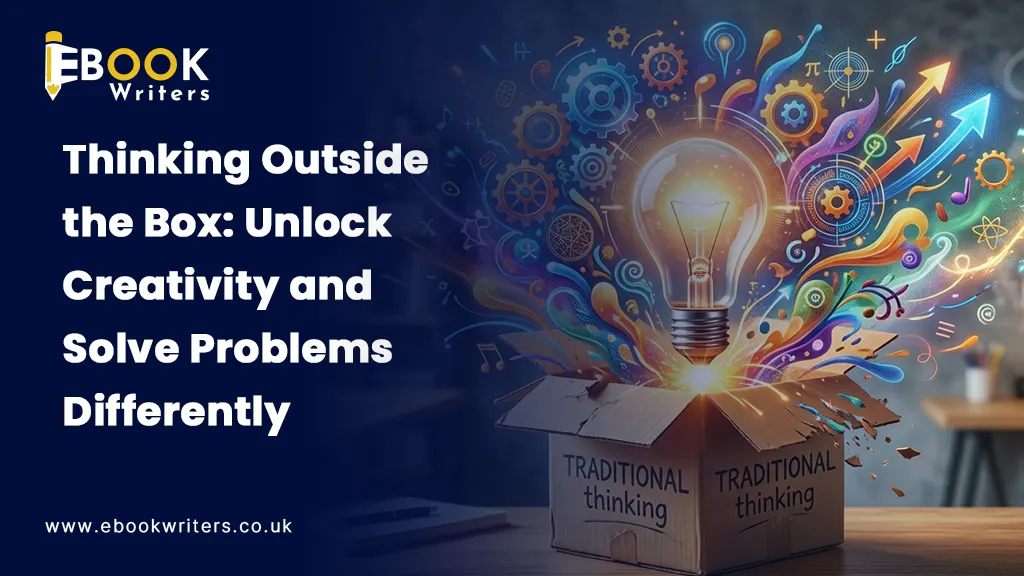
No innovation is made based on something already familiar. Often, the most significant advances in business, education, science, and everyday life begin with thinking outside the box.
This attitude fosters creativity, skepticism, and the exploration of alternative viewpoints and solutions not immediately apparent through traditional approaches. Whether it is meant to enhance workplace performance, become a better leader, or boost creative talents, unconventional thinking can turn ordinary problems into opportunities.
What does Thinking Outside the Box mean?
Thinking outside the box means creatively approaching a problem rather than relying on familiar methods.
Furthermore, it makes you think beyond obvious solutions, question current practices, and explore new possibilities that can lead to better outcomes.
It is a skill developed through curiosity, experimentation, observation, and a continual process of learning. All solutions are innovative, starting with the ability to question the current patterns.
Define Forward Thinker
A forward thinker is one who thinks ahead, looking beyond the present situation to opportunities, challenges, and trends that lie ahead.
Forward thinkers typically:
- Welcome innovation
- Be flexible and adaptable to change
- Continuous learning should be an ongoing investment.
- Plan strategically
- Encourage experimentation
- Forecast customer requirements
- Embrace emerging technologies
Leaders who predict change, instead of reacting to it after it happens, are valuable to organizations. Furthermore, thinking outside of the box is the perfect way to make a< difference. For example, book writing services help authors bring their innovative voice out by helping them publish their books.
What is Creative Thought?
Creative thought is the process of generating new ideas, synthesizing existing ideas, and finding creative solutions.
Creative thought involves:
- Imagination
- Observation
- Curiosity
- Flexibility
- Experimentation
- Pattern recognition
- Problem-solving
Creativity is not limited to the realm of art; all scientists, engineers, health care professionals, teachers, entrepreneurs and managers use creativity to get better results.
It also plays a significant role in workplace productivity and employee satisfaction, further cementing its relevance across industries, according to Adobe's State of Create research.
How to Think Outside the Box?
Critical Thinking develops through daily practice rather than occasional inspiration. By following different techniques, anyone can think outside of the box.
1. Challenge Existing Assumptions
Many limitations exist simply because people accept them as they are and don't ask questions.
Whenever you encounter a problem, question yourself:
- What is the purpose of doing this process in this manner?
- Is the rule still relevant?
- What if one of the important assumptions went away?
Simple questions expose the opportunities behind the existing problems.
2. Discover New Fields of Knowledge
Innovation is often at the crossroads of disciplines.
A marketer with a psychological approach, a designer with a design focus, or a teacher with a technology approach each gains a different perspective from their respective specialties.
Reading ebooks and books across a wide range of subjects expands mental links, which help facilitate creative problem-solving.
3. Embrace Challenges
The idea that unlimited resources stimulate creativity is widely believed. Recent studies suggest otherwise.
When budgets, timelines, and resources are limited, people are encouraged to come up with simpler, more economical solutions because they have no time for unnecessary complexities.
There have been numerous articles in Harvard Business Review about how constraint can be the fuel that enables innovation, as it pushes teams to focus on the most critical ideas or features rather than on what can be added.
4. Observe Problems Carefully
Successful innovators invest a lot of time in understanding the problem, and then think about the solution.
Instead of asking:
What are the improvements needed for this product?
Ask:
What issues are still not resolved?
Proper identification of the problem makes it more likely to find meaningful innovations and allows thinking outside the box.
5. Welcome Constructive Failure
Knowledge is not the constraint to creativity, it's the fear of failure. Each failure is a valuable learning lesson that will improve the next attempt.
The lesson to be taken from setbacks is that many successful entrepreneurs and inventors see them as opportunities to learn rather than permanent setbacks.
To build resilience, you need to experiment – and that experimentation can drive innovation.
6. Change Your Environment
A different environment can stimulate thinking. The brain learns to see patterns when you're walking, in a new place, or when you change your workspace.
Numerous organizations are creating co-working spaces because they believe that environmental changes encourage idea generation and better creative discussion.
7. Use a Curiosity Journal
Sometimes we don’t document the ideas, which is a big problem. Hence, always keep a journal for noting down:
- Interesting observations
- Business ideas
- Customer frustrations
- Questions worth researching
- Creative solutions
- Inspirational quotes
Thinking Outside the Box Examples
By exploring scenarios in which thinking outside the box made a difference, one can gain insight into creative thinking. The examples show originality in solving real-life problems in various industries.
1. Netflix Reinvented Entertainment
Netflix started as a DVD rental company that would rent DVDs to its customers. The company was planning to alter consumer habits rather than make improvements to physical rentals, and was investing heavily in online streaming.
This move changed the face of entertainment and how millions of people watched movies and television shows around the world.
2. Airbnb Changed Hospitality
For decades, hotels took the center stage concerning housing. The model was disrupted by Airbnb, which enables homeowners to rent out their rooms and even their entire homes.
The platform avoided building expensive hotels by directly linking travellers with property owners, a new business model that emerged.
3. Apple Simplified Technology
Other tech vendors tried to outdo each other with added buttons and complicated features. Apple maintained simplicity, an intuitive design, and a user-friendly experience.
The iPhone proved the opposite – less complexity leads to greater user satisfaction.
4. LEGO Satisfied Customers
Before involving the community in LEGO product development, LEGO sales were declining.
The company invited fans to submit product ideas, among which many would become success stories. Co-creation became an effective innovation tool.
5. Remote Work Revolution
In the past, companies thought that productivity was related to being physically at work.
The progress of collaborative tools, digital communication and cloud computing proved that distributed teams could be productive and more flexible.
This transition had a significant impact on the culture of the work environment in many industries.
6. Libraries Becoming Community Hubs
The modern library is not a place that only rents out books.
Many of these now offer coworking spaces, technology workshops, podcast studios, career coaching and entrepreneurship programs. This shift is an example of rethinking a service and generating value for the community.
Critical Thinking Thesaurus
A useful critical thinking thesaurus contains terms commonly used in relation to thinking and reasoning.
| Term | Meaning |
|---|---|
| Analysis | To examine a certain situation carefully |
| Evaluation | Assess the quality of a certain thing |
| Interpretation | To understand the meaning |
| Reasoning | To conclude logically. |
| Reflection | Review your ideas |
| Judgment | Take good decisions |
| Logic | Using facts to answer |
| Objectivity | To be neutral |
| Assessment | Check effectiveness |
| Discernment | Know the small differences |
Another Term for Thinking outside the Box
Here is the list of synonyms for thinking outside the box.
| Synonym |
|---|
| Creative thinking |
| Innovative thinking |
| Lateral thinking |
| Divergent thinking |
| Visionary thinking |
| Imaginative thinking |
| Inventive thinking |
| Original thinking |
| Nontraditional thinking |
| Breakthrough thinking |
30 Pairs of Idioms with Thinking Outside the Box Meanings
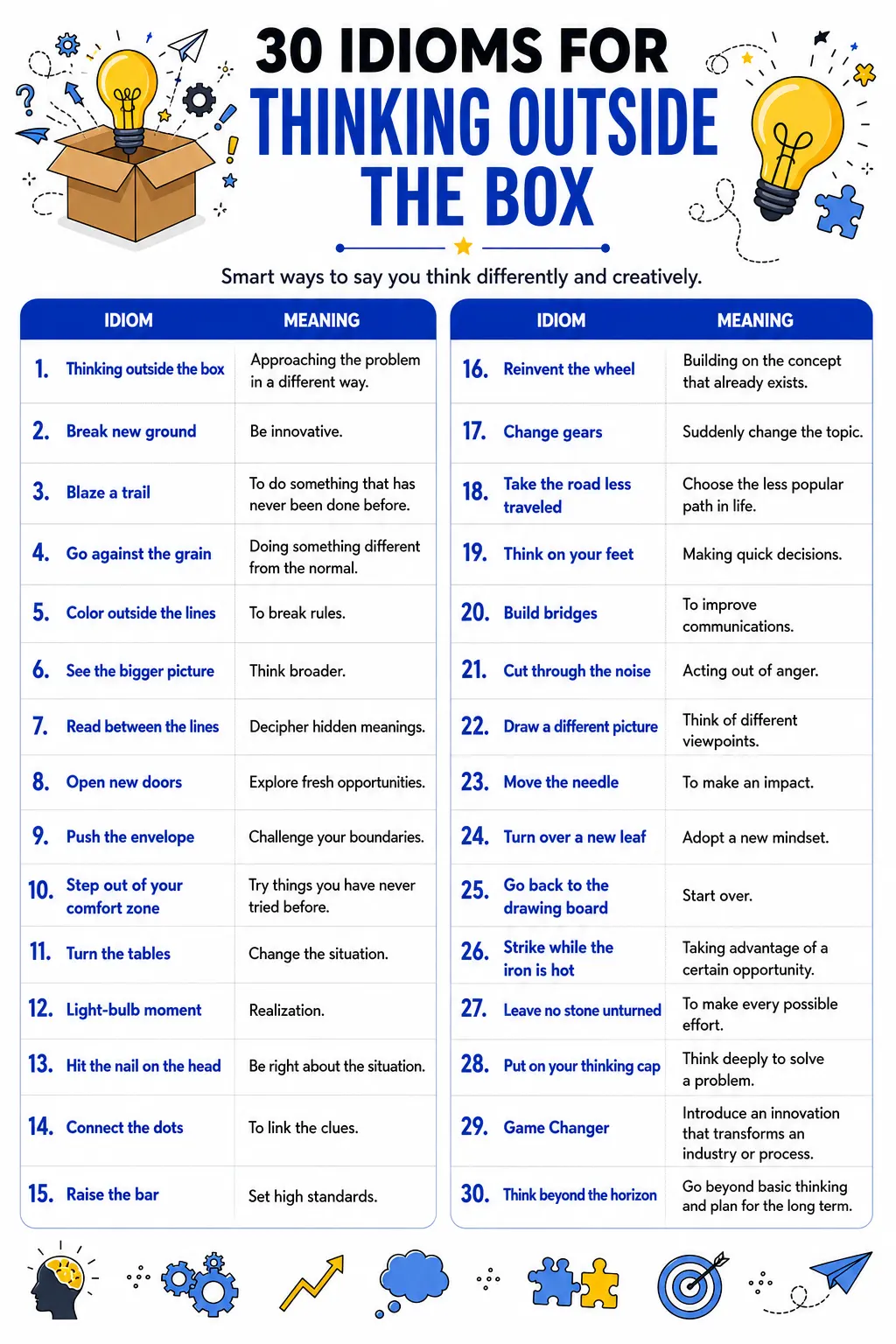
| Idiom | Meaning |
|---|---|
| 1. Thinking outside the box | Approaching the problem in a different way. |
| 2. Break new ground | Be innovative. |
| 3. Blaze a trail | To do something that has never been done before. |
| 4. Go against the grain | Doing something different from the normal. |
| 5. Color outside the lines | To break rules. |
| 6. See the bigger picture | Think broader |
| 7. Read between the lines | Decipher hidden meanings. |
| 8. Open new doors | Explore fresh opportunities. |
| 9. Push the envelope | Challenge your boundaries |
| 10. Step out of your comfort zone | Try things you have never tried before |
| 11. Turn the tables | Change the situation. |
| 12. Light-bulb moment | Realization |
| 13. Hit the nail on the head | Be right about the situation. |
| 14. Connect the dots | To link the clues |
| 15. Raise the bar | Set high standards |
| 16. Reinvent the wheel | Building on the concept that already exists. |
| 17. Change gears | Suddenly change the topic |
| 18. Take the road less traveled | Choose the less popular path in life. |
| 19. Think on your feet | Making quick decisions. |
| 20. Build bridges | To improve communications. |
| 21. Cut through the noise | Acting out of anger. |
| 22. Draw a different picture | Think of different viewpoints |
| 23. Move the needle | To make an impact |
| 24. Turn over a new leaf | Adopt a new mindset |
| 25. Go back to the drawing board | Start over |
| 26. Strike while the iron is hot | Taking advantage of a certain opportunity. |
| 27. Leave no stone unturned | To make every possible effort. |
| 28. Put on your thinking cap | Think deeply to solve a problem. |
| 29. Game Changer | Introduce an innovation that transforms an industry or process. |
| 30. Think beyond the horizon | Go beyond basic thinking and plan for the long term. |
Wrap Up!
Thinking outside the box is more than just a phrase. Instead, it is a mindset that encourages curiosity, adaptability and continuous improvement.
Creative thinkers know how to question different things and challenge ordinary perceptions. Building this skill requires practice. By reading widely, learning from your failures and collaborating with others, you can learn how to think out of the box.
FAQs
1. What is meant by thinking outside the box?
Ans: To think outside the box means to view a problem in an imaginative way, rather than the way you normally do. It promotes new ideas and creative solutions.
2. What is the purpose of thinking outside the box?
Ans: The power of creative thinking helps with problem-solving, fosters innovation, boosts workplace productivity, and facilitates a culture of change.
3. Is it possible to teach creativity?
Ans: Yes, You can develop creativity through practice, curiosity, continued learning, experimentation and exposure to other thoughts and experiences.
4. What is the difference between critical thinking and creative thinking?
Ans: Critical thinking involves using logic and evidence to assess ideas, while creative thinking involves generating new ideas. The two blends create better decisions.
5. What are some things that you do every day to make yourself more creative?
Ans: Creativity is reinforced through reading books and ebooks, brainstorming, asking thought-provoking questions, learning new skills, working with people from different backgrounds, and reflecting on experiences.
6. What is another saying for thinking outside the box?
Ans: Creative thinking, innovative thinking, lateral thinking, visionary thinking and divergent thinking are common alternatives.
7. How does reading enhance creativity?
Ans: Reading good books opens new horizons in the mind, increases vocabulary and familiarises readers with concepts from various fields and cultures.
How much time do you think it takes to become a creative thinker?
8. What does it mean to read between the lines?
Ans: Reading between the lines is to understand an implied message, as opposed to only the exact wording used.