info@ebookwriters.co.uk
 +44 7460 751919


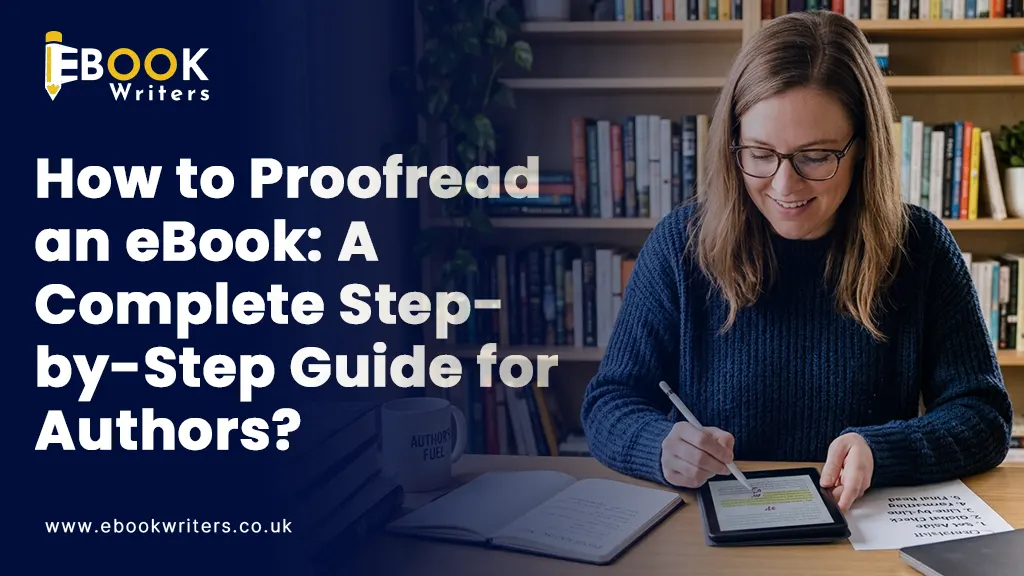
When it comes to writing a book, academic paper, or any form of writing, a lot of people think that writing is the hardest aspect of the practice. And the writing is completed.
However, it is not the case that once you finish your manuscript, your book is not ready for publication. Because you have to proofread an eBook.
Well, there is more to publishing practice than writing a manuscript. It does not matter which path you choose, self-publishing or you want to do to the traditional path, you must write an engaging manuscript.
This is where ebook proofreading plays a key role in ensuring your paper is free of mistakes and typos. Small and minor mistakes like typos, grammar slips, and factual inaccuracies erode reader trust and disrupt engagement.
Hence, in this guide, I will teach you how to proofread an ebook in quick steps.
What is eBook Proofreading?
The last step before an automobile is ready to hit the showroom floor is proofreading, and the same holds true for ebooks.
All the sound work of writing, revising, and formatting is on you. Also, proofreading is a quality-control measure that identifies and eliminates small, persistent errors such as typos and missing commas.
Other issues that may arise during digitization include formatting issues.
When reading an eBook, a typo is annoying, but a broken link or missing chapter marker can ruin the whole experience.
Hence, proofread an eBook is the final check to make sure your e-book looks great on any device, be it a smartphone, iPad, or Kindle.
Why Proofreading Matters
Well, skipping proofreading would be a huge risk. So, getting your eBook professionally proofread will give it a leg up in the market because it:
- Boost professionalism: Being professional sets your work apart from amateurish self-published manuscripts.
- Increase reader satisfaction: The reader is able to lose themselves in your story or ideas when you write in a smooth style.
- Reduce negative reviews: Anger over poor grammar is the surest way to lower a book's rating.
- Increase trust in your material: Finally, the audience will look to you as an authority when your writing is faultless.
Editing vs. Proofreading: Understanding the Difference
1. What is Editing
Editing and proofreading are different document preparation steps. Once you finish the first draft, every author hires a proofreading and editing service.
With so many online proofreading and editing services, authors can easily find a second opinion.
To help you write clearly and coherently, the editor and proofreader must know your field and subject-specific conventions.
2. What is Proofreading?
Proofreading, however, is a surface-level check. It is the last check usually performed on a document.
A skill proofreader will check for spelling errors, punctuation errors/misses, inconsistencies (textual and numerical), etc.
Editing, meanwhile, addresses core issues in writing, such as sentence construction and language clarity.
Moreover, good editing improves the readability, clarity and tone of the text. As a result, your writing will be read through and polished by proofread an eBook so that it flows.
When Should You Proofread an eBook?
After major writing, heavy developmental editing, and digital layout formatting, proofread your eBook.
Consider it your final quality-control check. No point in doing it sooner.
Rewriting text or changing the layout will introduce sneaky formatting errors and typos before publishing.
You should explicitly trigger a final proofread when needed.
- File conversion problems: After converting, check the Kindle and iPad text for clarity.
- Find hidden typos: Find the spelling errors that survived heavy editing.
- Check final formatting: Finally, the final formatting of proofreading an ebook should include working hyperlinks, page breaks, and table of contents markers.
Common eBook Errors That Proofreading Can Catch
Even the best eBooks can be thrown off course by small technical and grammatical oversights.
Formatting digital text often produces unseen glitches that normal word processors do not catch. Moreover, there are tons of authors who make ebook proofreading mistakes.
On the flip side, a good proofreader will catch these common errors before they go out. Hence, the specialist proofreader can easily create an ebook proofreading checklist.
Here are some E-book mistakes that a proofreader can catch.
- Format Conversion Glitches: Random line breaks, distorted images, text jumping around on Kindle/iPad screens.
- Hyperlinks: Non-working external links or malfunctioning table of contents tags that frustrate readers.
- Inconsistent Formatting: Unwanted variations in font sizes, heading colors, or styles of bullet points throughout chapters.
- Lingering Typos: Lastly, punctuation errors, homophone switches (their vs. there), and double spaces that didn’t get caught in the first edit.
Do you want to proofread an eBook like a Pro?
Connect with our certified and experienced team of proofreaders. Our proofreaders have solid attention to detail, a keen eye and precision.
Hence, your document will be free from mistakes, typos and any spelling.
Engage Now
How to Proofread an eBook Step by Step?
Digital files operate differently from print. So proofreading an eBook is a strategic, multi-step process.
Treat the process as a targeted hunt, not a casual read, to uncover every hidden flaw.
Here are the effective proofreading tips for authors.
Step 1: Step Away First:
First of all, put aside your manuscript for 48-hours. Fresh eyes can catch sneaky typos your brain automatically fixes when you are too close to the text.
Step 2: Change the Layout
You have to export to an e-reader or tablet. So, changing the font size and background color makes your brain read the text as a customer would.
For example, a line break misplaced in Word will look fine but will be immediately obvious on a Kindle screen.
Step 3: Check All Links:
You can also manually click each Table of Contents entry and each external URL. Further, broken links to your website impact your credibility and annoy your readers.
Step 4: Utilize Text to Speech:
Lastly, listen to the book being read by a program. Your ears will easily catch awkward phrasing or missing words that your eyes skip over if you utilize text-to-speech.
Best Techniques for Effective eBook Proofreading
Professional proofreaders use brain tricks to find all the hidden errors in the text.
Here are the best and most effective proofreading techniques.
1. Ear Reading Text-to-Speech Scan
In the first step, you need to follow along as your computer or e-reader reads the book.
Your ears will catch awkward phrasing, missing words, and accidental repetitions (like “the the”) that your eyes miss.
2. The Trick to Disrupt Format
Now you have to swap fonts and boost text size. And then set the screen background to sepia or dark.
You physically alter the words on the page to fool your brain into thinking it is reading a new book. Therefore, typographical errors stand out immediately.
3. Isolated Backward Read
From the last sentence of a chapter to the beginning, read your manuscript sentence-by-sentence.
This breaks the narrative flow, so you can only judge each sentence by its spelling and grammar.
4. Multi-Pass Targeted Proofing
Instead of trying to catch everything at once, read the eBook several times, focusing on one issue.
For instance, check chapter titles and formatting first, punctuation second, and hyperlinks last.
Moreover, avoid Proofread an eBook in the same program you wrote it.
As a result, saving your file to an e-reader replicates your buyers' experience and reveals layout errors that word processors hide. Finally, you have to provide a finalebook review once you are done with your proofreading.
Should You Hire a Professional eBook Proofreader?
Yes, indeed, you need an expert proofreader, as no author is a proofreader. Once you finish writing, there are many mistakes in your document.
Authors are tired of writing an ebook and are unable to spot mistakes. Here are the reasons to hire specialist ebook editing and proofreading services.
Benefits
- The "Blind Spot" Effect: Writers naturally skim their own work and self-publishingproofreading tips. Because they know the intended meaning, easily let typos and syntax errors slip by.
- Protect Your Reputation: Errors distract readers and can lead to bad reviews or lost credibility.
- Industry Standards: Both traditional publishers and discerning self-published readers expect error-free text
Signs You Need a Professional Proofreader
But if you are skimming over your own words, getting lost in the weeds of digital conversion glitches, or don’t have confidence in your grammar, you need a professional proofreader.
Cost Vs Value
Professional eBook proofreading costs $0.01 to $0.03 per word. While the typical investment for a standard 50,000-word manuscript is $500-$1,500.
However, proofreading is an upfront cash expense. But it prevents the bad reviews that tank your sales. Think of it as insurance for your author brand.
How Long Does It Take to Proofread an eBook?
Proofreading an e-book takes 1 to 7 days, but it depends on the word count. Also, it depends on the quality of the first draft and the text complexity.
In general, a certified proofreader reviews about 2000 words every hour.
Ending Note:
Hence, finishing your manuscript is a big milestone. But proofreading an e-book is what turns raw writing into a professional, high-selling eBook.
Also, you have to use strategic measures or invest in the services of a trained eye to protect your author brand from adverse reviews.
And then let easy-to-correct typos ruin your hard work. Finally, give your eBook the perfect finishing touch that your readers deserve.
FAQs
1. How many times should I proofread an eBook before publishing?
You must proofread your book at least 3 to 5 times
2. What is the difference between ebook editing and proofreading?
An ebook editor aims for the bigger picture and the whole writing. Proofreading is a final practice that focuses on technical aspects such as typos and grammatical mistakes.
3. Can Grammarly replace a professional proofreader?
No, of course not. Grammarly is just a tool, similar to an AI that cannot replace authors. But it is an effective proofreading tool that can help authors save a lot of time and money.
4. How do I proofread an eBook for Kindle publishing?
In order to proofread a book for Kindle Publishing, you have to finalize your manuscript and examine it for formatting mistakes. And then preview how it shows to readers.
5. What are the most common mistakes found in eBooks?
The most common mistake in eBooks is insufficient planning.